After her spitting interview, we asked Tatyana Gabellone, if she had wanted to interview her coach Mark Wall, to also have an idea of the thought of an English coach (though native to Australia) on race walking as seen through the eyes usually different from ours.
Both have agreed.
We publish in full, which does not mean that we completely agree with Mark Wall, especially on the last two answers to the questions that have been asked.
We respect his ideas, but Marcia dal Mondo believes that the application of technology (in training and in the top races) in putting all the athletes in the same conditions of objectivity would be a deterrent to the controversy, sometimes specious, that sometimes flourish in our world.
Regarding in Pit Lane, the second chance given to the young athlete to complete the race, then maybe out of contention for medals, would allow the specialties of not losing potential young future that could one day grow.
We see it, but thank Mark Wall for his contribution although diametrically opposed to our ideas.
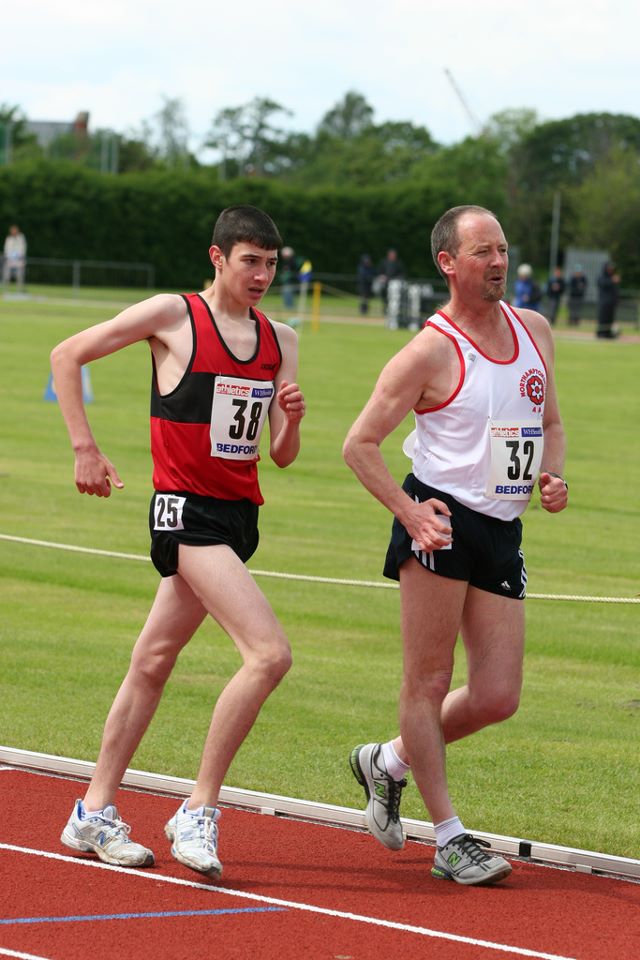
Mark Wall (bib 32) today at Inter-Counties race
L'intervista
(by Tatyana Gabellone)
1.- Quando ha cominciato a marciare ? Ha auto qualche difficoltà nell'apprendere il gesto o le ė venuto quasi naturale ?
Ho iniziato a scuola nel 1973 ed ho gareggiato nei “Victorian Schools Championship” nel 1973 (Australia) quando avevo 17 anni. Mi ero iscritto ad un club appena prima della gara ed è iniziato tutto da lì. Ho gareggiato ininterrottamente per quel club per 16 anni. Ho una tecnica molto rudimentale. Mi è venuto relativamente facile marciare ma col tempo ho migliorato e raffinato.
Devo dire che il mio primo allenatore, Harry Summers (poi divenuto allenatore della nazionale australiana), la prima volta che mi ha visto mi ha detto che ero il peggior marciatore che avesse mai visto! Credo di aver imparato molto quando ho partecipato alla Lugano Cup a Eschborn nel 1979; è stato più un apprendimento subconscio.
2.- Quando ha cominciato ad allenare ?
Ho iniziato nel 1991 in Australia (è lì che ho ottenuto la mia certificazione) ma ho sperimentato su me stesso con diverse modifiche sul mio programma in collaborazione con Harry dal 1987 in poi.
Ho allenato sia in Australia che in UK ma in genere ho avuto solo un piccolo numero di atleti alla volta, e spesso molto giovani o Master, nessuna delle quali categorie richiede programmi di allenamento pianificati estensivamente. Non ho avuto l’opportunità di lavorare con il lato più d’elite dello sport finchè non è arrivata Tatyana.
3.- Lei è stato un atleta, ora è un allenatore, ma anche un giudice. Come vede il rapporto tra allenatori e giudici?
Credo che tutti e tre siano i lati di uno stesso triangolo. Ciascun atleta cerca il meglio da se stesso ma deve imparare dai propri “insuccessi”. L’allenatore deve essere consapevole degli errori del suo atleta e correggerli, per fare questo deve lavorare con le osservazioni dei giudici.
Il compito del giudice è di permettere al maggior numero di persone di finire la gara (per quanto la regola lo permetta) usando le palette di richiamo. Troppo spesso gli allenatori cercano di intimidire i giudici o i giudici possono prendere un tono superiore. Entrambi questi atteggiamenti sono sbagliati. I giudici devono essere aperti a domande ragionevoli, gli allenatori aperti al dialogo, dopo tutto il giudice può avere un fondamentale pezzo di informazione che consente all’atleta di evitare future squalifiche.
4.- Lei è anche coinvolto nella gestione dello sport, di che cosa si tratta?
Sono sempre stato coinvolto in questo aspetto dello sport. Ho ricoperto ruoli a livello di club, locale, regionale e nazionale. Molti di questi sono stati nell’ambito dell’ Atletica in generale piuttosto che specificamente nella marcia. Questo sia in Australia che nel Regno Unito. Ho ricoperto ruoli che comportavano selezione di squadre di Track & Field, marcia e fondo, sono stato coinvolto nell’organizzazione di meeting di atletica e marcia, sono stato coinvolto in Team Management sia in Track & Field (squadre regionali) e marcia (squadre regionali e nazionali) .
Sono in un certo numero di comitati per l’England Athletics ed ora anche per la British Athletics (guardando a strutture per competizioni di atletica in generale). Adesso diventerò “Acting Chair” (presidente) di un consiglio regionale nell’ambito dell’England Athletics e quindi questo vuol dire che sarò membro del consiglio nazionale. Tutto questo non viene retribuito, e quindi significa dover prendere giorni liberi a lavoro. Sono stato onorato di essere stato scelto come “Volontario Nazionale dell’anno” per England Athletics. Sono anche un funzionario qualificato Track & Field e funzionario per le gare di fondo (campestri e corse su strada).
4.- Come vede la marcia oggi in GBR ?
La Gran Bretagna è ora su un percorso di miglioramento, questo ha comportato tanto duro lavoro per il “National Centre of Excellence” presso la Leeds Beckett University, sotto il suo direttore, Dott. Andi Drake. Tom Bosworth e Jo (Jackson) Atkinson sono i prodotti di questo centro. Ne hanno anche beneficiato i neozelandesi Quentin Rew ed Alana Barber, così come gli irlandesi Brendan Boyce ed Alex Wright (in precedenza GBR).
L’England athletics ha avuto un programma di sviluppo nazionale di “Coach Mentors” in tutte le discipline. Questi mentori dovevano lavorare per sviluppare le abilità di altri allenatori. L’idea è di sviluppare allenatori non lavorare con squadre di atleti. La marcia ha avuto un numero sproporzionatamente alto rispetto ai gruppi di altri eventi. Questi allenatori hanno lavorato a stretto contato con Andi e Martin Rush per sviluppare un ethos di continuo miglioramento. Molti dei migliori atleti in UK lavorano con allenatori che al momento sono nel programma oppure hanno uno status di laureati.
Stiamo iniziando a vedere dei risultati di vero livello internazionale ma esiste un problema di un elemento associato con la disciplina, chi rappresenta il passato, accusa l’attuale gruppo di atleti sia di non essere bravi come gli atleti di precedenti generazioni o di non essere “marciatori corretti”. Questo è dovuto alla presenza di video o fotografie. È giusto dire che ci sono due gruppi, quelli che sono coinvolti con il governo nazionale (British Athletics o England Athletics) e quelli che guardano agli altri gruppi come coloro che rappresentano le autorità nello sport.
Un altro grosso problema è che per apatia, motivi storici o altre ragioni la marcia è stata al di fuori della corrente principale dell’atletica, alcuni come Andi, Martin, Martin Bell e il Dott. Ian Richards, così come il sottoscritto lavorano duramente per cercare di cambiare questa situazione. Adesso abbiamo una gara di marcia su invito nella finale dei National Youth Development League (una competizione su pista), la marcia è ritornata nei campionati nazionali indoor e le qualificazioni dei giudici di marcia saranno ora responsabilità della British Athletics piuttosto che della Race Walk Association. Bisogna che la marcia sia più presente nei programmi di gare in pista.
6.- Questo è molto diverso alla tua patria: l’Australia? Se sì, come ?
In Australia, dalle categorie giovanili (età 5-15) fino ai Senior (dagli 11 anni in sù), la marcia è parte integrante di ogni manifestazione su pista. Questo implica meetings praticamente ogni settimana. In parallelo in ogni regione ci sono gare di marcia durante tutto l’anno svolte da club di marcia, prevalentemente come le gare di corsa su strada. Le iscrizioni di questi club sono fatte da persone che sono anche soci di club di Track & Field, sono membri di entrambi. La marcia ha sempre fatto parte della corrente principale, non ottiene sempre il miglior trattamento ma è lì ed ha la sua voce in capitolo.
Molte persone coinvolte nella marcia hanno avuto uno stretto coinvolgimento con l’organizzazione dello sport stesso. Io ero uno di quelli. Il presidente della giuria di selezione nazionale track & field è un ex marciatore olimpico. Uno dei suo predecessori era anche lui un marciatore.
Significativamente, l’attuale successo dell’Australia, in parte, si può far risalire alla metà degli anni 70 e attraverso gli anni 80. Un numeroso gruppo di allenamento si sviluppò a Melbourne. Tim Erickson era un novizio ed un luminare. Il braccio amministrativo della marcia a Victoria, il Victorian Race Walking club, erano aperti a nuove idee e guardavano ad ulteriori opportunità per gli atleti, accadde una riforma di idee creative.
Lo sviluppo del programma di Marcia dell’Australian institute of Sport sotto i vari allenatori ha iniziato a portare medaglie internazionali.
7.- Come vede oggi la marcia in Europa e nel Mondo ?
Questa è una domanda interessante. Se facciamo un confronto con 30 anni fa, gli schieramenti sono più piccoli in tutto il mondo in eventi domestici ma il livello continua a salire. In UK nel 1984, più di 140 marciatori hanno preso parte alla 20 km nazionale, ora si ha difficoltà ad ottenerne 10 di un livello equivalente nello stesso evento. Gli schieramenti Australiani nei campionati nazionali sono più piccoli. Questo ovviamente non è vero nei paesi in via di sviluppo come Cina, Giappone, e Corea o in alcuni paesi del Sud America. La Russia continua ad avere un elevato numero di marciatori (ma su questo dirò di più in seguito). Tuttavia ci sono molte più distrazioni o sport alternativi.
Ho iniziato questo sport quando la URSS, GDR e Messico erano le centrali elettriche. Di queste solo la Russia post-rottura ha ancora una grossa influenza. Il Messico è ancora una principale presenza ma senza lo stesso impatto. La Germania sembra non tenere la stessa influenza.
L’Irlanda, considerate le sue dimensioni, sta facendo particolarmente bene. Francia ed Italia hanno una presenza quando si tratta di prendere medaglie e l’Ucraina si sta mettendo in evidenza. Piuttosto che avere solo tre atleti dall’URSS, la precedenti repubbliche ora possono schierare le loro squadre (riconosco che questi atleti da allora sono cresciuti o non erano neanche nati ai tempi dello scioglimento dell’URSS).
La Marcia femminile si è davvero sviluppata molto e continua a farlo. Lo IAAF Challenge rende possibile essere marciatori a tempo pieno e da l’opportunità ai buoni atleti di testare se stessi contro altri in competizioni di alto livello. Lo sviluppo di una 50 km di marcia per donne potrebbe essere interessante, coloro che al momento si valutano da soli sarebbero scioccati, credo che piuttosto che considerare 4:10 come un ottimo tempo, si potrebbe prevedere qualcosa come 10-15 minuti in meno.
Non posso rispondere a questa domanda senza menzionare il doping. È un disastro per la disciplina. C’è bisogno di fare pulizia degli atleti disonesti e degli allenatori a loro associati. L’attuale fallimento delle date selettive per l’applicazione delle penalità (prima o dopo un’Olimpiade) si presta al ridicolo. Sono anche uno di quelli che pensa che probabilmente assisteremo presto ad un’ondata di squalifiche per integratori contaminati, una severa responsabilità si adopera sempre.
8.- Cosa pensa si possa fare per promuovere la marcia in GBR e, in generale, anche in altri paesi ?
Credo che la Marcia debba apparire negli ordinari programmi dell’Atletica, delle divisioni, ecc., non in gare separate tenute da qualche altra parte. Per lo meno i campionati dovrebbero essere tenuti insieme ai campionati di prove multiple. C’è bisogno che i giudici di marcia siano multi-disciplinati si sviluppino come giudici in altri campi dell’atletica.
Nel Regno Unito dobbiamo zittire gli elementi negativi all’interno della disciplina. Sì è vero ci sono foto che mostrano atleti in “fase di volo” ma questo è dovuto più alla qualità della fotografia digitale che alla disonestà.
Dobbiamo continuare a coinvolgere nei “Park Run” settimanali in giro per il paese (ed ora anche nel mondo), sono manifestazioni gratuite, ti iscrivi su internet, ti presenti e partecipi, e 2-3 ore più tardi trovi il tuo tempo su internet. Un’iniziativa economica guidata da volontari dove puoi avere una sessione di 5km (si può anche incorporare all’interno di una sessione più lunga attraverso la marcia nel luogo di svolgimento).
In altri paesi suggerirei anche un coinvolgimento diretto con le gare di atletica in pista; tuttavia sono meno attrezzato per commentare. Abbiamo bisogno di comparire in più e principali eventi di corsa su strada? C’è il bisogno delle iniziative di “Park Run” in ciascun paese per portare maggiormente la marcia agli occhi del pubblico?
9.- Pensa che la tecnica di marcia sia cambiata nel tempo ?
Sono vissuto attraverso una gamma di cambiamenti di regole. Molte hanno a che fare con l’elemento ginocchia o la comunicazione giudice-atleta durante l’evento (“Warnings/Cautions/Reports”, le parole cambiano).
Il Regno Unito ci ha messo un po’ di tempo prima di impiegare la regola IAAF, hanno usato il sistema di un richiamo e sei fuori per molti anni o una diversa interpretazione della “regola del ginocchio”. Anche adesso, ci sono le cosiddette “gare B”, dove le ginocchia non vengono giudicate. Il motivo è che i novizi, giovani o anziani marciatori non riescono ad attenersi completamente alla regola IAAF. Trovo questo molto sbagliato. Se non si è in grado di fare una gara in base alle regole allora non si deve fare la gara. Se non si è in grado di passare gli ostacoli, non si può semplicemente sbatterci contro per poterli passare, se non si riesce a superare una siepe non si ci può girare intorno, perché deve essere diverso per la marcia? È stato ridicolo quando nei campionati nazionali della 50 km abbiamo avuto due gare, il vincitore sotto le regole IAAF, ha vinto il campionato britannico ma non il campionato dell’Associazione di marcia (medaglia e trofeo) nonostante il migliore sia stato significativamente più veloce!
Mi va bene l’attuale regola e la componente “dell’occhio nudo”. Qualsiasi introduzione di apparecchi elettronici non potrà mai essere applicata ovunque nel mondo!
10.- Cosa ne pensa del "Pit Lane, Rule", al fine di aiutare i giovani atleti per finire, in ogni caso, la gara ?
Sono in disaccordo con questa regola come concetto, potrebbe essere un’idea di valore nel suo scopo ma è troppo problematica e potrebbe insegnare una lezione sbagliata. Come uno con un po’ di allenamento teologico, la redenzione è un concetto di valore ma si hanno già tre possibilità prima della squalifica. Un’atleta potrebbe prendere il rischio in gara, trasgredire spingendo troppo duramente, ottenere un vantaggio insormontabile, e addirittura usare il tempo di penalità in maniera benefica, venendone fuori avvantaggiato?
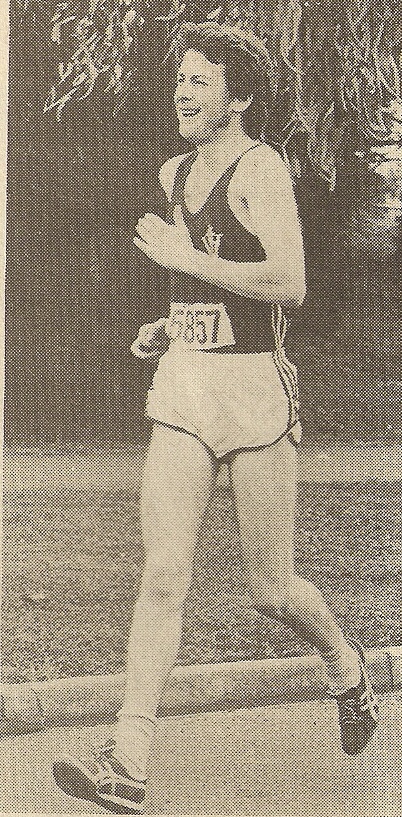
Mark Wall in 1980

The interview
1.- When did you start to walk? Did you have any difficulties in learning walking or was it quite natural ?
I started at school in 1973 and competed in the Victorian Schools Championship in 1973 (Australia) when I was 17. I joined a club just prior to that and it went from there. I competed continuously for that club for 16 years. I have a very rudimentary technique. It came relatively easily but it was improved and refined over time. I must say, my first Coach, Harry Summers (Later Australian National Coach), did say, the first time he saw me, that I was the worst walker he had ever seen! I think I learnt a lot when I attended the Lugano Cup at Eschborn in 1979; it was more a sub-conscious learning thing.
2.- When did you start Coaching ?
I started in 1991 in Australia (this is where I gained my qualifications) but I had experimented upon myself with different variations on my program in co-operation with Harry from 1987 onward. I have coached both in Australia and the UK but have generally had only small numbers of athletes at any one time and often these are very young or Veterans, neither of whom require overly extensively planned training programs. I miss the opportunity to work with the more elite end of the sport until Tatyana came along.
3.- You have been an athlete, now you are a coach but also a judge. How do you see the relationship between coaches and judges?
I I think that all three are, if you like, sides to the one triangle. Each athlete seeks the best of themselves on the day but they need to learn from their ‘failures’. The coach need to be mindful of his or her athlete’s faults and rectify them, to do this they need to work with the observations of the judges. The task of the judge is to enable as many people to finish a race (as far as the rules allow) by use of the warning paddles. Too often coaches can try to intimidate judges or judges can take a superior tone. Both of these attitudes are wrong. Judges need to be open to reasonable questions, coaches open to dialogue, after all the judge may have a vital clue piece of information which enables an athlete to avoid future disqualifications.
4- You are also involved in the administration of the sport, what does this involve?
I have always been involved in this side of the sport. I have held positions at club, local, Regional and National level. A lot of this has been in Athletics as a whole rather than specifically race walking. This has been in Australia and the UK. I have held positions involving Selection of Track & Field, Walking and Endurance teams, I have been involved in the planning of Track & field and Walks meets, I have been involved in Team Management in both Track & Field (regional teams) and Race Walking (Regional and National teams). I am on a number of committees for England Athletics and now for British Athletics (looking at Competition Structures for athletics as a whole). I am now to be Acting Chair of an England athletics Regional council so this means I will be a member of the National Council. This is all unpaid, so this means days off work. I was honoured to be chosen as England Athletics ‘National Volunteer of the Year’. I am also a qualified Track and Field Official and Endurance Official (Cross Country and Road Races).
5.- How do you see now race walking in GBR?
Great Britain is now on a path of improvement, it has taken a lot of hard work from The National Centre of Excellence at Leeds Beckett University, under its director, Dr Andi Drake. Tom Bosworth and Jo (Jackson) Atkinson were products of this centre. New Zealanders Quentin Rew and Alana Barber were also beneficiaries as was Irishmen Brendan Boyce and Alex Wright (previously GBR).
England athletics has had a program of nationally developing a ‘Coach Mentors’ across the whole sport. These Mentors were to work with developing other coach’s skills. The idea is to develop coaches not work with squads of athletes. Walking has had a disproportionately higher number than other event groups. These coaches have worked closely with Andi and Martin Rush to develop an ethos of continuous improvement. Many of the best athletes in the UK work with coaches who are either currently on the program or else have graduate status.
We are starting to see really international standard results but the problem exists of an element associated with the event, who represent the past, they deride the current crop of athletes as either being not as good as those in a previous generation or else not being ‘fair walkers’. This is due to the curse of video or photographs. It is fair to say two groups exist, those with involvement with the National Governing Body (British Athletics or England Athletics) and those who look to other groups as being the authority in the sport.
Another big problem is that for apathetic, historical or other reasons walking has been outside of the mainstream of athletics, some such as Andi, Martin, Martin Bell and Dr Ian Richards as well as myself work hard to look for change this. We now have an invitation walk in the Final of the National Youth Development League (a Track & Field Competition), the Walk is back in the National Indoors and walk Judging qualifications will now be the responsibility of British Athletics rather than the Race Walk Association. There needs to be more walks in Track and field programs.
6.- Is this different to your homeland Australia? If so how?
In Australia, from Little Athletics (ages 5-15) through to Senior Athletics (11 upward), walking is integral to any Track and field competition. This involves meetings pretty much each week. Parallel to this in each region there is walks competitions throughout the year conducted by Race walking clubs, predominantly as road races. The membership of these are made up of people who are also members of Track and field clubs, you are members of both. Walking has always been part of the mainstream, it does not always get the best deal but it is there and has its say.
Many people involved in walking have had a close involvement with the organisation of the sport itself. I was one of those. The chairman of the National Track and field selection panel is an ex Olympic walker. One of his predecessors was likewise a walker.
Importantly, the current success of Australia, in part, can be traced back to the mid-1970s’ and through the 1980s. A large training group developed in Melbourne. Tim Erickson was an early adopter and leading light. The administrative arm of walking in Victoria, the Victorian Race Walking club, were open to new ideas and looked to further opportunities for the athletes, a deal of ‘Blue Sky’ thinking happened.
The development of the Walks program at the Australian institute of Sport under the various coaches started to bring international medals.
7.- How do you see now race walking in Europe and in the World?
This is an interesting question. When compared to 30 years ago, Fields are smaller worldwide in domestic events but standards continue to rise. In the UK in 1984, more than 140 walkers started in the National 20km, now you struggle to get 10 of an equivalent standard in the same event. Australian fields in National Championships are smaller. This is not of course true in the developing countries such as China, Japan, and Korea or in some South American countries. Russia continues to have large numbers (but more of this later). There are, however, a lot more distractions or alternate sports.
I came into the sport when the USSR, GDR and Mexico were the powerhouses. Of these only a post break-up Russia has as big an influence. Mexico is still a major presence but without the same impact. Germany does not seem to hold the same sway.
Ireland, for its size, is doing particularly well. France and Italy have a presence when it comes to the medals and the Ukraine is showing to the fore. Rather than just three from the USSR, the former Republics can now field their own teams (I do acknowledge that these athletes have either grown up since or were not born at the time of the breakup of the USSR).
Women’s walking has really developed strongly and continues to do so. The IAAF Challenge makes it viable to be a full-time walker and affords good athlete opportunities to test themselves again others in high standard competition. The development of a 50km walk for women could be interesting, those currently rate themselves will be in for a shock, I suspect that rather than 4:10 being a great time, something like 10-15 minutes quicker may be foreseeable.
I cannot answer this question, without mentioning doping. It is a disaster for the discipline. There needs to be an active cleaning out of cheats and the coaches associated with them. The current fiasco of selective dates for application of penalties (either side of an Olympics) just lends itself to ridicule. I am also one of those persons who think it likely that we are yet to see a rash of suspensions for tainted supplements, strict liability always applies.
8.- What do you think can be done to promote race walking in GBR and in general also in other countries ?
I think that walks need to appear in the standard program of Track and field, leagues etc, not separate races held elsewhere. Hold Championships with the combined Events championships at least. Walks judges need to be multi-disciplined develop themselves as officials in other spheres such as Track or field officials.
In Britain, we need to silence the negative elements within the discipline. Yes there are pictures showing athletes with ‘flight time’ but that is more due to the quality of digital photography than it being due to cheating.
We need to continue involvement in the weekly ‘Park Run’ around the country (and now world), it is a free competition, register online and turn up and compete, and you get your time online 2-3 hours later. A low cost volunteer driven initiative where you get a 5km session (you could incorporate it into a longer session by race walking to the venue).
In other countries I would also suggest direct involvement in Track and field; however I am less equipped to comment. Do we need to appear at more major road running events? Is there the need for ‘Park Run’ initiative in each country to get walking more in the public eye?
9.- How do you think the walking technique has changed through time?
I have lived through a range of rule changes. Many to do with the knees element or Judge-Athlete communication in the event (Warnings/Cautions/Reports, the words vary).
The UK took some time to adopt the full IAAF rule, the use a one report and you are out system for many years or a different interpretation on the ‘knees rule’. Even now, there is what is known as ‘B races’, where knees are not judged. These are almost the norm now. The rationale being that newcomers, young or older walkers cannot comply fully with the full IAAF rule. I find this very wrong. If you cannot do an event according to the rules you need to not do the event. If I cannot hurdle, I cannot just knock them over to get past them, if I cannot clear a steeple barrier, I cannot run around it, why is race walking different? It was farcical when in the National 50km Championship, we had two races, the winner under IAAF rules, won the UK Championship but not the Race Walk Association Championship (medal and trophy)despite being the best significantly quicker!
I am happy with the current rule and the "naked eye" component. Any introduction of electronic devices can never be applied world-wide!
10.- What do you think about the "Pit Lane Rule" in order to help young athletes to finish in any case the race ?
I disagree with it as a concept, it may be a worthy idea in its aim but it is too problematic and it may teach a wrong lesson. As someone with some theological training, redemption is a worthy concept but you do already have three chances before disqualification. Can an athlete take the gamble in a race, transgress by pushing too hard, get an insurmountable lead, even use the penalty time beneficially, coming out advantaged?
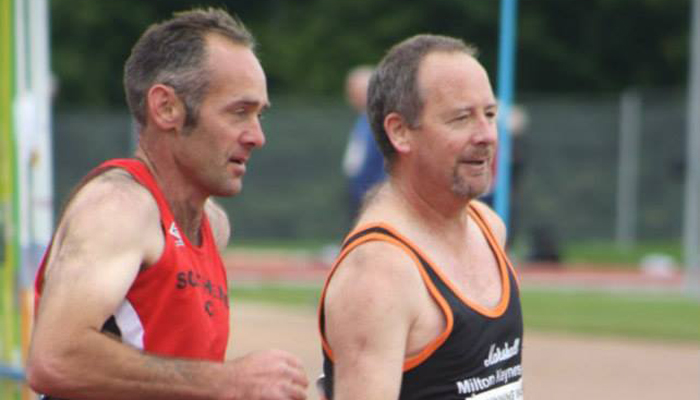
Mark Wall (first) during a master race