The news that we publish are taken from the site of the FIDAL (in the Italian edition of Marcia dal Mondo) and from the IAAF web-site for the edition in English.
We apologize to our readers, but two days after the race, would not make sense to do our part of the report, when on this subject have already been written important pages.
In the coming days we will make some comments.
(from IAAF web-site by Paul Warburton)
10 km U20 women
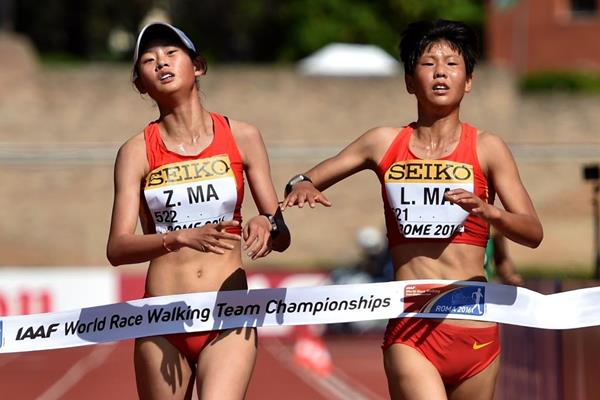
The U20 women’s 10km at the IAAF World Race Walking Team Championships Rome 2016 proved to be a cracking race with a real burn-up over the last 300 metres between the two leading Chinese race walkers.
As Ma Zhenxia and Ma Li shot through the finish line there was no impression of a conveniently agreed and possibly diplomatic tie. Both clearly wanted the victory, and it needed a photo finish to separate them by an amazing six-thousandths of a second – the first time any race at any World Cup has seen leading race walkers finish on the same second.
There was a brave bronze for Mexico’s Valeria Ortuno three seconds later, not only rewarded with a medal for refusing to yield when the pace ratcheted up, but a personal best by 15 seconds and an area U20 record on a day when new marks were few and far between.
Earlier, everyone toed the line in the shadow of the Constantine Arch and strode out down the Via di San Gregorio like Roman troops 2000 years ago – except these junior women were going a fair bit quicker.
Even so, a clutch of race walkers appeared to belie their personal bests to head to the front of the field including Finland’s Taika Nummi alongside Tayla-Paige Billington wearing the green and gold of Australia.
Right behind, Ma Li and Italy’s Noemi Stella were putting on a show for home fans, but the pace was still a modest 14:03 going through 3km.
Shortly after, the cap-wearing Ma Zhenxia came level at the front for the first time and the leading group of 18 started to splinter with remnants flying off the back.
Germany’s Teresa Zurek was next to chance her arm at the front, and the sudden injection of pace reduced the phalanx to nine.
It was no wonder. The pace had shot up to 23:12 for halfway with Ortuno also making her first bid for glory.
By 6km the charge had reduced the numbers to six with Australia’s Zoe Hunt having the race of her life just about hanging on to the leaders’ coat tails, but also labouring under the threat of two disqualification cards that soon turned into all three.
Just before 9km, there was an almighty sprint from Ma Zhenxia, who lit the afterburners of a 44:29 personal best from March.
She looked a comfortable first, but was soon looking over shoulder as her teammate and Ortuno gave chase.
Ma Zhenxia, the world youth champion, gave it a second burst to lose her pursuers, and still they came back at her.
Going on to the track, there was at last daylight between China and Mexico, but at the finish line, only technology made the division.
Back in the day of the naked eye, a recorder would surely have made it a tie.
Stella came home a good fourth, and Nummi looked delighted with fifth.
Needless to say, China took the team prize, Mexico were second, and Australia third.
At least three race walkers were given a two-minute pit stop in a bold experiment designed to spare athletes the ignominy of total disqualification.
Once a third card came in, as it did for Hunt, they were shepherded into the sidings and set back on their way after two minutes.
As an idea it has legs, and allowed the fallen to put theirs back into action and complete the race.
The winner has a thicker vest than the difference between she and second, but a win is still a win.
"It feels pretty good to win after very hard training," Zhenxia said. "The beginning of the course is difficult but the rest of it was very good
"I won today thanks to my relaxed attitude, and because there was a strong field."
The second Ma was in doubt about the winner until technology made the difference.
Li explained: "We did not know who had won, and we had not planned to finish together." And although it was only fourth for Stella, it was as good as gold.
"I felt like I won," the Italian said. "I had two terrible months because of a back injury. As a result, I did not expect to finish fourth, but I just gritted my teeth throughout and just kept my rhythm."
10 km U20 men
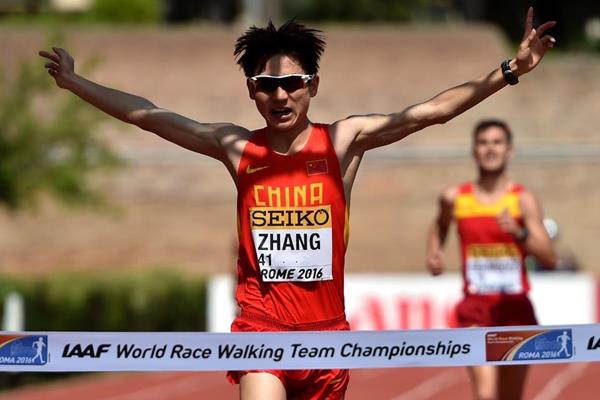
The future is so bright for Zhang Jun that he was the only race walker in the first three at the IAAF World Race Walking Team Championships Rome 2016 who needed sunglasses.
However, the Chinese athlete was cast into bright sunlight as he strode home to underline his status as the pre-race favourite.
Behind him, there was a terrific scramble to mount the podium won by Manuel Bermudez from Spain to set a four-second personal best, and Mexico’s Noel Chama came third after a charge in the latter stages to pip Callum Wilkinson from Great Britain.
There was no hanging about from Wilkinson as he shot away at the start.
The fair-haired white-vested native from Newmarket is fresh from a 41:31 personal best recorded in March, and looked a thoroughbred as he rattled through the first four kilometres.
Zhang has gone even faster, and it was mere seconds before he made up the ground to Wilkinson. At 4km, he made his own push to be home alone.
The Brit was joined by Cesar Rodriguez from Peru, the only top-10 survivor from the 2014 IAAF World Junior Championships, China’s Jin Xiangqian, Rodriguez’s teammate Lenyn Mamani, Spain’s Bermudez and Japan’s Masatora Kawano to enhance the eclectic mix.
Halfway was reached by Zhang in a speedy 20:22, with the others a mere two seconds back.
By 6km there was clear daylight between the chasers and the leading pack now down to Chama, Zhang, Wilkinson, and Bermudez.
Behind the quartet, the Peruvian pair were desperately trying to stay in touch, desperate being the operative word as the leaders hit 32:58 for 8km.
Shortly after, Wilkinson was next to feel the heat, and not just the Roman rising sun, but the injection of pace from Zhang as he made five metres on Bermudez, who in turn carved out the same, despite a great walk from the Great Briton.
Wilkinson dug deep to close the gap, and lost it in the next 100 metres, with the Spaniard storming after the Chinese leader.
The short but quick striding Zhang ate up the ground over the last kilometre to make certain of his win, and Bermudez also had a bit of daylight to spare to win silver.
However, a magnificent last 150 metres between the tiring Wilkinson and Chama, who clearly got a second wind in the second half of the race, excited the throng at the finishing line.
The two were as far opposite as possible on the track heading to the line, but it was the Mexican who prevailed. Wilkinson’s razor sharp race walk was rewarded with another personal best, this time in 40:30 to take more than a minute off his own national junior record. His fourth-place finish was the highest position achieved by a Briton in any race at these championships since 1979.
The winner, however, claimed he was far from certain about gold on the start line.
“At the beginning I felt my condition was not so good,” said Zhang, the world youth silver medallist. “It must be the weather; it was a bit too hot. In the last six kilometres I felt my energy would not be enough. I tried to adjust and then I perked up.”
Bermudez felt the warmth of the sun and a family gathered to cheer him on.
“I’m very satisfied,” he said. “I gave it my all because the race was difficult, it was really hot. My family is here and I feel supported. Before we started, I was hoping for a fast race like it has been in the past, but I didn't think I would be on the podium.”
Chama enjoyed the benefit of bronze and qualification for the IAAF World U20 Championships Bydgoszcz 2016 in July.
“It was a tough race – and I knew it would be, because it was my first season as an U20,” he said. “It’s a great moment for me as I made the qualification standards to compete in Bydgoszcz. Hopefully, I will have the opportunity to compete with the senior national team in just a few years.”
Mexico were team champions, and newcomers Peru earned a magnificent team silver, with the improving Japanese taking the final medal.
20 km men
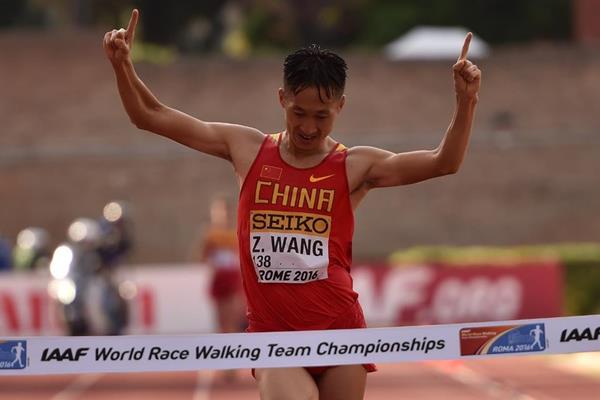
When it mattered, the pedigree of Wang Zhen shone through for an emphatic 20km gold at the IAAF World Race Walking Team Championships Rome 2016.
Parts of the course in the shadow of the Colosseum were shaded, but when it came to a duel, no one was able to match the heat of a last four-kilometre sprint from the two-time world silver medallist.
Wang won this competition in 2012, and four years later his speed was such it provided the only draft for lapped race walkers caught in his wake as he made for the line.
He had bided his time through a succession of pretenders who darted ahead and were reeled in like so many fish before the big one got away.
Wang looked reasonably untroubled as he moved through the gears, and behind him Chinese teammate Cai Zelin also seized the chance to increase the revs, albeit at a distance.
His was an equally decisive drive for bronze, won by Spain’s Alvaro Martin from the fast-improving Dane Bird-Smith, who nonetheless notched a second personal best of the year – and this time by 26 seconds.
But it took a while for the race to ignite.
There is always one rabbit caught in the headlights on these occasions. In the past it used to be injured world record-holder Yusuke Suzuki; this time it turned out to be another Japanese, Takumi Saito, obviously keen to pick up a bit of frontman status.
He was joined by 2011 world bronze medallist Kim Hyunsub, who decided it was his turn to be the only one in camera shot as he went through at a modest 8:03 for 2km.
Once Kim had his five minutes in the sun, the group – or rather throng of 51 race walkers – would have been covered by the same large blanket if a spectator around the historic course had cared to throw one.
Brazil’s Moacir Zimmerman was next to show with South Africa’s Lebogang Shange treading on his heels. The 5km mark was another modest 20:21, slower by a second than the junior men in the morning.
India were looking good for a team prize with three in the first 12, even though it was a fluid dozen, while Zimmerman struck out to head the rest and was left to his own devices for a lot longer than those before him.
Even so, he was swallowed up after another two plus kilometres, and this time the group was down to a more manageable 25 by the halfway point in 40:22 that betrayed a very even pace – one well within the scope of most of the frontmen.
Canada’s world bronze medallist Ben Thorne then took over lead duties despite claiming in casual conversation before the race that he would be the man following.
But even given the warm afternoon, the tempo was modest at this level.
Cai decided this was the moment to strike and quickly opened a four-second gap close to 13km. He too perished like the lone wolves before him, although by 14km at 56:14 the medals were going to be three from nine.
Defending champion Ruslan Dmytrenko was next to ease off the back. In Taicang two years ago, it was raining and cool. This race was hot and rough but it suited Wang to a tee.
Off he went into the distance never to be headed, and for about 200 metres over the final kilometre, Martin first drew level and passed Cai, who reacted almost instantly to retake second spot.
Martin, and not world champion Miguel Angel Lopez, was the Spaniard climbing on to the third step this time, and even though he was without a medal this time, Bird-Smith looked as if his career as a serious contender had just taken off.
China were comfortable winners ahead of a strong Canadian trio headed by Thorne in fifth. The sterling work from Andres Chocho one place further back was the cement that saw Ecuador plant their collective feet on the team podium for bronze.
The winner was phlegmatic about his latest victory.
“I did not think I had the right training to win a medal,” said Wang. “We just thought this was a good chance to test our condition before the Olympics, and it gives me confidence for Rio.”
Cai was likewise none too impressed with his silver.
“I am not too satisfied because I didn’t reach my ideal performance,” he said. “I don’t have many chances against Wang, and I am still far from his level. I will learn from him.”
But Martin was delighted with an unexpected third.
“This was a good competition with great Chinese and Japanese athletes, and a very good race ahead of the Olympic Games,” he explained.
“In the last 3km, I knew it was possible to win a medal and I had to be strong, it was so good. You have to do what makes you happy and race walking makes me very happy.”
20 km women
(by Jon Mulkeen)
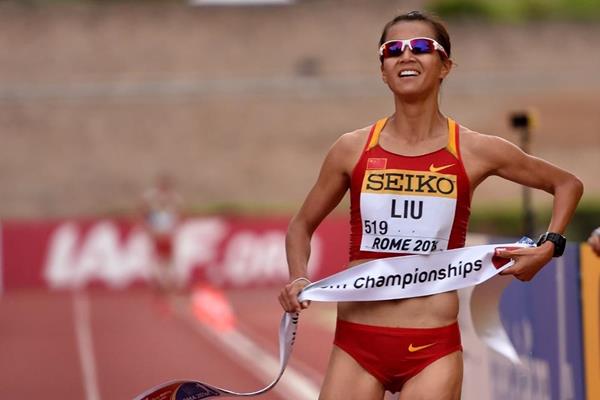
With her 20km victory at the IAAF World Race Walking Team Championships Rome 2016, Liu Hong is one step close to completing the grand slam of major race walking titles.
The Chinese race walker is the world record-holder and a two-time world champion. She also topped the IAAF Race Walking Challenge standings for the past two years and even won the world junior title back in 2006.
But the IAAF World Race Walking Team Championships is one title that, until today, had eluded the 28-year-old.
Showing no signs of feeling the effects of a recent cold she had mentioned at the pre-event press conference, Liu was always present at the front of the race. But she didn’t have it all her own way.
Mexico’s Maria Guadalupe Gonzalez set a national record of 1:28:48 at the 2014 edition of this event. Since then, she has been undefeated, winning the Pan-American title and various Race Walking Challenge events. She proved to be Liu’s toughest rival throughout the first half of the race.
Liu led a lead pack of seven through 5km in 22:10. Only four of those – Gonzalez, China’s Olympic silver medallist Qieyang Shenjie and home hope Eleonora Giorgi – were still in contact at half way, reached in 43:51.
But just before 12km, which was covered in 52:17, Liu Hong upped the pace and opened a gap on Gonzalez. Qieyang and Giorgi were locked in a battle for third place.
A few minutes later, Qieyang clipped a cone on the tightest turn of the two-kilometre loop, falling to the ground. But she regained contact with Giorgi within a minute of being back on her feet and then began to close on Gonzalez to challenge for second place.
A third Chinese 1-2 finish of the day began to look like a distinct possibility.
Liu, meanwhile, continued to plough on ahead. She passed 15km in 1:05:00, having covered the previous 5km in 21:09, and was some 14 seconds in front of Gonzalez and Qieyang. Giorgi’s chances of securing a medal in front of her home crowd were beginning to fade as she trailed six seconds behind the leading trio.
Just one lap later, a rejuvenated Giorgi rejoined Gonzalez and Qieyang in what became a three-way battle for two medals. But with two red cards to her name, Giorgi knew that she couldn’t afford to make any mistakes.
Qieyang eventually faded, leaving Giorgi and Gonzalez side by side. The Italian dug in and gritted her teeth in a desperate bid to take the silver medal. But shortly after Liu entered the stadium on her way to an assured victory, Giorgi was shown a third red card was disqualified, leaving Gonzalez alone in second place.
Liu crossed the line in 1:25:59, the second-fastest time in the history of the championships, to complete the Chinese sweep of all the individual gold medals on offer on Saturday.
“I was always in front but I felt a bit nervous because I didn't know if the others had more energy or if their rhythm could speed up,” said Liu. “I had to keep turning to check them and keep up my speed.”
Gonzalez smashed the North American record with her time of 1:26:17, outlining her status as a genuine contender for an Olympic medal.
Qieyang came through for third place in 1:26:49 while Brazil’s Erica de Sena finished fourth in a South American record of 1:27:18.
The biggest cheers were reserved for Italian veteran Elisa Rigaudo. At 35 years of age, the 2008 Olympic bronze medallist equalled her best ever finish at this event to place fifth in 1:28:03.
With four athletes in the top eight, China secured their seventh gold medal of the day by taking the team title. Australia, led by 12th-place finisher Regan Lamble, took team silver while Colombia clinched the bronze medal, just six points ahead of Portugal.
Having produced the most dominant performance of the day, Liu looks well on her way to completing her grand slam of titles at the Rio Olympics later this summer.
Full results (individuals, per teams and split times) of two days in the section Results or directly download from this link: click here
Video of 20 km women (by RAI-TV): click here
Video of 20 km men (by RAI-TV): click here
Le foto delgli arrivi (by getty Images)