Few in Europe knew her, but Maria Guadalupe Gonzalez Romero, was presented in Rome at the IAAF World Race Walk Team Championships with a well-fed cv.
The twenty six year old Mexican, who wanted to became a boxer, but she folded back to race walk after a knee injury, had had already two important victories in her credit, both obtained in the past year:
- that in Arica, Chile who had seen her victory in Pan-American Cup of May 09, 2015 with a time of 1:29:21
- that in Toronto, Canada who had seen victory at the Pan-American Games on July 19, 2015 with a time of 1:29:24
However, his personal best was obtained even a year before the latest edition of the World Cup Taicang, when she stopped the clock in 1:28:48 getting the sixteenth position.
It would have been hard to predict a qualitative leap as that obtained from the Mexican.
In the beautiful race of the evening in Rome, stimulated by comparison with Eleonora Anna Giorgi, Maria Guadalupe Gonzalez Romero, however, reduced her personal best exactly of 2:31.
This result represents the record NACAC (North America Central America and Caribbean) as well as that of Mexico, but it is also the second world performance of 2016 behind that of Liu Hong (1:25:56 obtained in Huangshan on March 06, 2016 ).
If we include the time of Olga Kaniskina (1:25:54 obtained in Sochi on February 27, 2016) her performance is the third of the year.
The new darling of the Mexican race walk, coached by Juan Hernandez and university student in Mexico City, dueled in a gritty way and in a spectacular race with Eleonora Giorgi, and was the true revelation of the Roman edition of the World Team Championships.
The day before the race, during the visit of the course, one of the glories of Mexico, Daniel Bautista, had told us that his Country hoped much of a good result of Mar.ia Guadalupe. We never timagined that the result was this.
The duel between the Mexican and the Italian was beautiful, exciting; there remains only the regret of never being able to know what would be the natural conclusion.
Now Maria Guadalupe Gonzalez Romero entered the "club under 1:27:00" which currently has only 29 female athletes "all time".
The club, led by Liu Hong, is composed of 20 female athletes of Russia, 5 athletes of China, one athlete of the Czech Republic, one athlete of Belorussia and Eleonora Anna Giorgi and Maria Guadalupe Gonzalez Romero, united not only in the race in Rome, but also in the final time.
These are the personal best of Maria Guadalupe Gonzalez Romero
| Event | Result | Venue | Date |
| | | | |
| 10.000m track | 48:38.86 | Zapopán (MEX) | 21.06.2013 |
| 10km road | 47:49 | Morelia (MEX) | 07.07.2013 |
| 20km road | 1:26:17 | Roma (ITA) | 07.05.2016 |
Questa la sua progressione negli anni nella 20 km
| Year | Results | Venue | Date |
| | | | |
| 2014 | 1:28:48 | Taicang (CHN) | 03.05.2014 |
| 2015 | 1:29:21 | Arica (CHI) | 09.05.2015 |
| 2016 | 1:26:17 | Roma (ITA) | 07.05.2016 |
(dal sito web della IAAF by Paul Warburton)
Had it not been for a knee injury, Maria Guadalupe Gonzalez would be swinging her fists rather than her legs and arms.
The Mexican race walker, like a fair few before her, came to the sport by accident rather than design.
The 20km silver medallist at the IAAF World Race Walking Team Championships Rome 2016 was forced to abandon hopes of boxing at the first Olympics to include women in 2012, and look for another route to fame and sporting glory.
Gonzalez took up running but soon discovered the knee was still a problem.
Cue the advice of a sports doctor in a country where race walking has been something of a national obsession since Jose Pedraza took silver at the 1968 Olympics in Mexico City.
The army sergeant’s last lap into the stadium where he first passed Soviet race walker Nikolay Smaga and was two strides from heading the great Vladimir Golubnichiy proved to be the stuff of legend.
The same coach as Pedraza’s guided dozens of top Mexican men to Olympic, World Championships and World Cup success, but Jerzy Hausleber drew a blank on champions from the fairer sex.
Mexico had just one senior World Cup women's medal before Saturday, a silver, won by Gabriel Mendoza in 1991, with other honours confined largely to Pan American and South American competition.
Gonzalez, though, could be the one to change all of that.
Doing the translation honours in Rome for the non-English speaking Mexican was none other than a man who knows exactly what it takes to break a world record, as well as win Olympic, World Championships and World Cup golds.
Jefferson Perez was as fascinated in the media tent as the journalists to hear Gonzalez’s tale from the boxing ring to race walking.
“I didn’t like race walking originally,” she said. “I wanted to be a boxer, and I thought I was quite good. As well as walkers, Mexico has also produced very good professional and amateur boxers.
“But I had problem with my knee, and it needed physiotherapy. The doctor who was treating me said race walking would allow me to stay fit for endurance work without the impact on my knee that boxing and running bring, so I tried it. Maybe God wanted me to be a race walker all the time.”
Whether it was divine intervention or sheer hard slog, Gonzalez improved dramatically since she took her first steps three years ago at the age of 24, a much later start than the average top race walker.
In one of her first ever competitions, she won the Mexican title in the 10,000m race walk. Little more than two weeks later, she won gold at the Central American and Caribbean Championships on home soil in Morelia.
She made her 20km debut at the start of 2014, clocking 1:33:42, but then smashed that by five minutes when she finished 16th at the IAAF World Race Walking Cup in Taicang, setting a national record of 1:28:48.
She went undefeated throughout 2015, winning at the IAAF Race Walking Challenge meeting in Chihuahua, the Pan-American Cup in Arica, and at the Pan-American Games in Toronto.
Her winning streak continued into 2016 when she successfully defended her title at Ciudad Juarez in March, winning by more than 500 metres. But despite her string of victories, her PB made her just the 20th-fastest woman on the entry list for Rome.
By the end of the race, though, she was among the quickest women there.
Gonzalez and Italy’s Eleonora Giorgi were the last to fall off the back of the brilliant Liu Hong, who claimed she was not entirely fit but was still good enough to beat a quality field.
Gonzalez was finally on her own when Giorgi was disqualified just short of the finish, and the Mexican believes her silver medal in a scintillating area record of 1:26:17 – which takes her to 23rd on the world all-time list – owed much to a course that started in the shadow of the Colosseum, and ended on a nearby athletics track via a two-kilometre loop.
“I actually enjoyed the course in Rome, because surprisingly there was a lot of shade and many trees,” said Gonzalez, who covered the second half in 42:26, quicker than the area record in the women’s 10km race walk. “I was expecting it to be more in the open and in sunlight.
“I was only at 1:28 before, so to do what I did was something of a surprise,” she added. “But when you are at this level of competition, you can be inspired by the competitors around you, and that helped a great deal.
“I am of course very pleased to do this time. Does it give me extra hope for a medal in Rio at the Olympic Games? Of course. A lot of the walkers who will be there are here at the Team Championships in Rome, and it will be hot in Brazil as well.”
Gonzalez shook her head when asked why it has taken nearly 50 years for Mexican women to make the breakthrough, but thinks the logical obvious of casting the medal net wider might have something to do with it.
“I don’t know why it’s taken so long for women to make their mark in Mexico, but the country’s athletics federation knows walking has been traditionally a good path to medals,” she said.
“If men can win medals, then why not women? It means Mexico can have even more medals, and we now have a chance to do that if women work as hard as men have in the past.
“This medal in Rome means I now have the reasons to work even harder.”
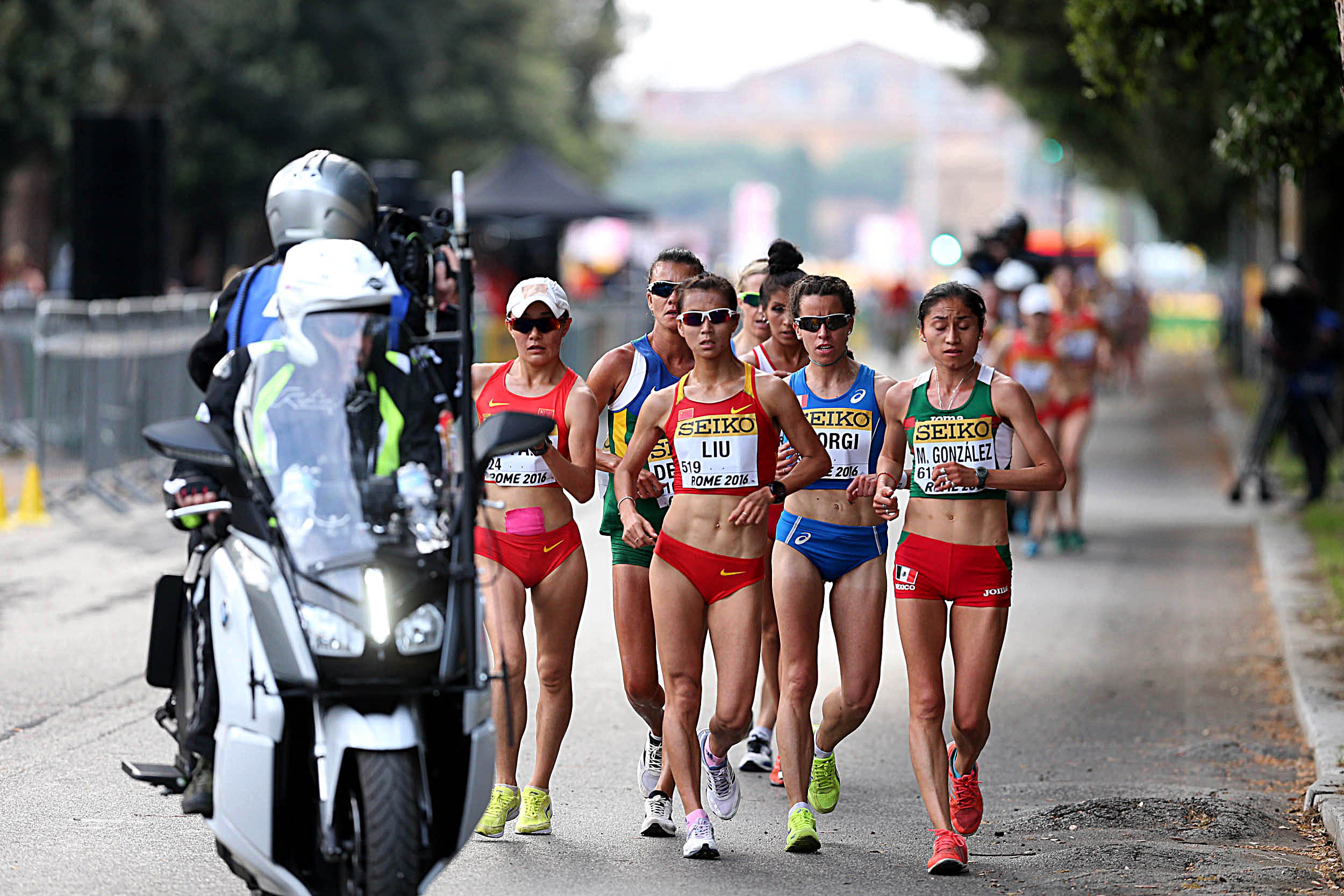
Leading group in first part of the race (photo by Giancarlo Colombo for Fidal)
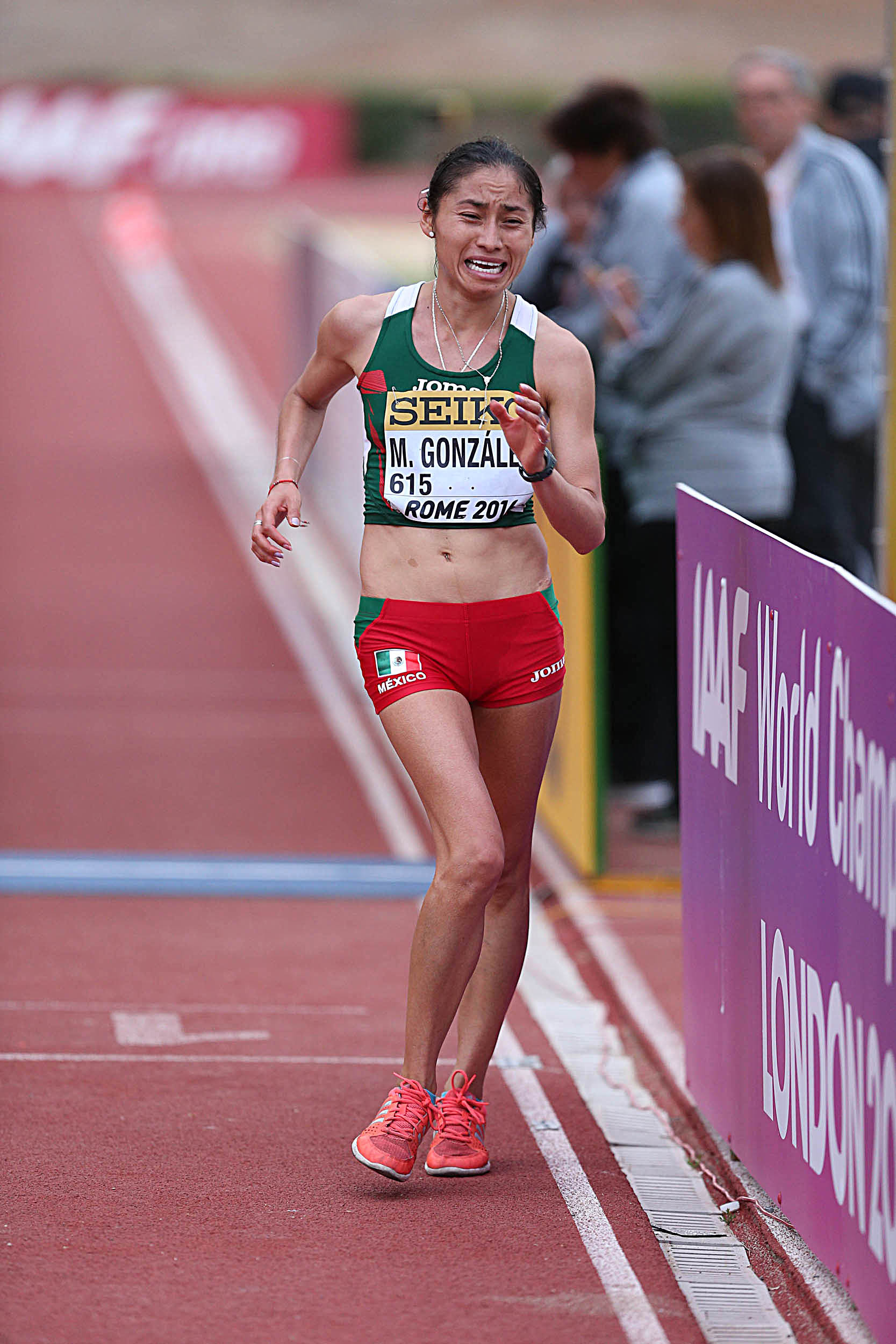
The arrival of Maria Guiadalupe Gonzalez in 1:26:17
(photo by Giancarlo Colombo for Fidal)